
Review · SANTIAGO
Half-Day Small-Group Panoramic Santiago Tour
Santiago in four hours, minus the stress. I like the small-group feel, and I love the hotel pickup and drop-off that removes the hardest part of city touring. In one go, you’ll see major civic sights, learn the stories behind the architecture, and finish with a look at how locals actually eat at the Mercado Central.
One thing to keep in mind: the day moves at a fast clip, and if a timed stop is closed or delayed, your time for photos can feel a little tight.
In This Review
- Key Highlights at a Glance
- A Tight Half-Day That Builds a Real Map of Santiago
- Hotel Pickup and the Club Hípico Architecture Fix
- Downtown Santiago: Paseo Ahumada, the Cathedral, and La Moneda
- Plaza de la Constitución and Civic District Exteriors
- Two Hill Options: San Cristóbal for Panoramas, Santa Lucía for Old Volcano Drama
- San Cristóbal Hill: Big City Orientation from Above
- Santa Lucía Hill: Founding-Era History on a Volcano Remnant
- Bellavista and Pablo Neruda: From Art Streets to a Craft Shop
- Fine Arts Museum Area: Parque Forestal and Why It Matters
- Modern Parks and the Sanhattan Angle
- Central Market: Mercado Central and Real Local Food Life
- Price, Group Size, and Whether This Feels Like Value
- What I’d Watch For Before You Book
- Should You Book the Half-Day Panoramic Tour?
- FAQ
- How long is the half-day panoramic tour?
- What is the group size for this experience?
- Do I get hotel pickup and drop-off?
- Which hill can I choose to visit?
- What major downtown sights are included?
- Are any admission tickets included?
- Is Central Market included?
- Is food included in the price?
- What if the weather is bad?
- Is there free cancellation?
Key Highlights at a Glance
- Small group max keeps the tour personal, not chaotic
- Choose your big viewpoint with San Cristóbal Hill or Santa Lucía Hill
- Old Santiago to modern Santiago in one logical route
- Bellavista plus Pablo Neruda context gives the neighborhood a real story
- Mercado Central stop lets you pair sightseeing with local food life
- Hotel pickup and drop-off makes this easy when you are short on energy
Other ways to walk the capital, reviewed
- Private Santiago City Half Day Tour
★ 4.0 · 414 reviews - Museo Chileno de Arte Precolombino Admission Ticket
★ 4.5 · 118 reviews - Half-Day Small-Group Panoramic Santiago Tour
★ 4.0 · 89 reviews - 2-Hour Walking Tour of Yungay The Coolest Neighborhood in Chile
★ 5.0 · 85 reviews
A Tight Half-Day That Builds a Real Map of Santiago
This is the kind of tour I recommend when you want an instant sense of where everything sits. Santiago can feel spread out, and this run stitches together the political center, the hills, and the artsy streets into one flowing picture.
You’ll start with pickup from your hotel and ride in an air-conditioned van. Then it’s a mix of short walks, quick photo stops, and a couple of longer view moments. The best part is that you are not just collecting landmarks. You’re getting the reasons behind them, from why certain buildings were designed the way they were to how the city’s neighborhoods evolved.
The route is also practical for first-timers. You see the downtown grid and the cultural districts, plus you get one of the big skyline angles from above. That makes it much easier to plan what you want to revisit later.
Hotel Pickup and the Club Hípico Architecture Fix
Most half-day tours start with “let’s see the highlights.” This one starts with a highlight with actual architecture clues.
After pickup, your van heads to the Club Hípico de Santiago (Equestrian Club). The tour explains how the elegant design took inspiration from a similar club in France. Even if you are not an architecture person, this works because it teaches you how to look. You start noticing form, layout, and the way prestige buildings often try to signal status through style.
From there, you continue through one of Santiago’s oldest and wealthier areas, with an architecture-themed focus. The point here is not to memorize facades. It’s to understand how the city’s identity has layers, older and newer, all piled together.
Downtown Santiago: Paseo Ahumada, the Cathedral, and La Moneda
Downtown is where you get your “okay, this is the center” feeling, fast.
You pass through Paseo Ahumada, a long downtown shopping street connecting Plaza de Armas to Universidad de Chile. It’s a simple stop, but it helps orient you. If you end up walking around later, you’ll understand the direction the city wants you to move.
Next comes the Catedral Metropolitana. It’s the seat of the archbishop, and construction began in 1753 and finished in 1799 under Italian architect Gioacchino Toesca. The cathedral is a free stop, which matters when you are trying to keep the budget under control.
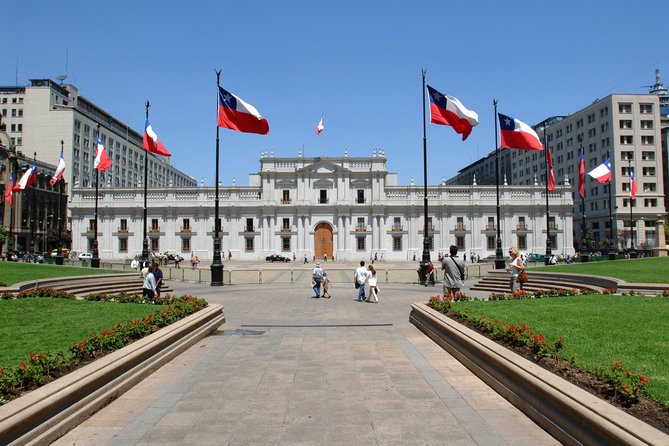
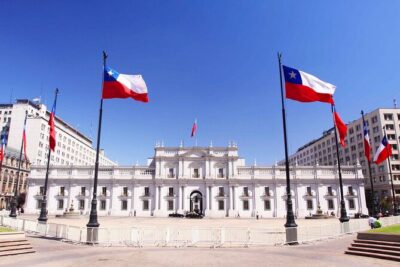
Then you reach La Moneda, Chile’s presidential palace and a cabinet hub. You’ll see it as part of the civic block, and the tour frames it as the center of government life. Timing-wise, this area is often active, so expect quick viewing and photos, not a long sit-down.

Plaza de la Constitución and Civic District Exteriors
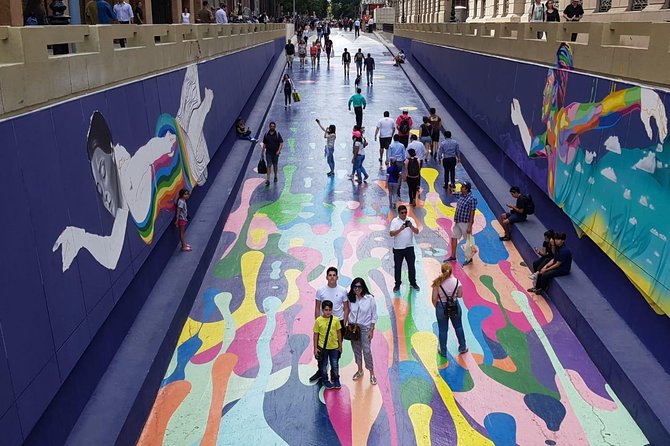
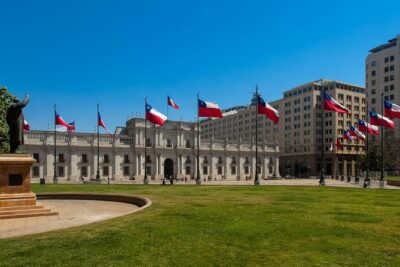
After the big-government moments, the tour keeps you in the civic zone. Plaza de la Constitución occupies an entire square block in front of La Moneda, surrounded by other government buildings.
This is a good moment for practical learning. You see how the administrative power lives right beside the public face of the city. The tour also points out nearby institutions around the same district, and even if you do not go inside many of them, the exteriors help you connect the dots later when you read or watch Chile news.
You might also stop at the Centro Cultural Palacio de La Moneda. The description you’ll hear centers on the glass-slab roof that floods the underground spaces with natural light, plus the ramps that lead you through the atrium toward temporary exhibitions. It’s a free stop and worth it when you want a small break from outdoor walking.
Two Hill Options: San Cristóbal for Panoramas, Santa Lucía for Old Volcano Drama
This is the decision that changes the feel of the tour. You pre-select either Cerro San Cristóbal or Cerro Santa Lucía, and you’ll spend time at the top with big views.
San Cristóbal Hill: Big City Orientation from Above
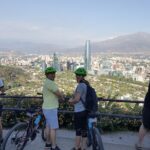
San Cristóbal is one of Santiago’s top viewpoints, and the tour treats it with respect. You’ll go up and get a wide panorama that helps you orient the city against the Andes and the Cordillera de la Costa.
In the best-guided versions of this tour, the ride and the viewpoint time are the highlight. I’ve seen guides like Daniel and Erick praised for pacing and for going the extra step to point out what you are actually seeing from the summit.
San Cristóbal admission is included when this option is selected. The time on the hill gives you a real chance to look, not just stand for five seconds.
Santa Lucía Hill: Founding-Era History on a Volcano Remnant
Santa Lucía has a different personality. It’s tied to deep time and founding lore. It is the remnant of a 15 million-year-old volcano. Conquistadors used it as a lookout point. Pedro de Valdivia declared the founding of Santiago there in 1541.
Then in 1872, Governor Benjamin Vicuña Mackenna turned it into a commemorative park. You’ll see a landscaped hill experience with bronze gates, metal stairways, fountains, and statues across about 65,300 square meters.
Santa Lucía admission is included when selected, and the stop is timed so you get both the history story and the scenic value.
Bellavista and Pablo Neruda: From Art Streets to a Craft Shop
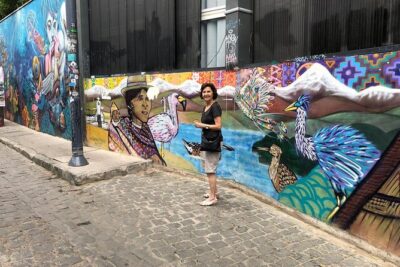
Once you drop out of the civic core, you head toward Bellavista, and the vibe shifts quickly. This is Santiago’s bohemian quarter, between the Mapocho River and San Cristóbal Hill, known for art galleries, boutiques, restaurants, and late-night energy.
The tour also builds the neighborhood context by connecting it to Chilean poet Pablo Neruda. It specifically references his Santiago home, La Chascona. Even if you do not enter it, hearing the connection helps you understand why Bellavista has that creative pull.
Between Bellavista and the Central Market, there’s typically a traditional Chilean craft shop stop. This is where you can pick up small souvenirs that feel local rather than generic. If you hate shopping tours, treat this as a browse moment, not a spending mandate.
Fine Arts Museum Area: Parque Forestal and Why It Matters
Santiago’s art scene is not an afterthought, and the tour threads you into it through the Fine Arts Museum.
You’ll visit the Chilean National Museum of Fine Arts, known as one of the major centers for Chilean art and broader South American art. It was established in 1880, and the current building, the Palace of the Fine Arts, dates to 1910 in a Beaux-Arts style. The museum sits in Parque Forestal, a park along the Mapocho River that connects several downtown cultural spots.
This stop is valuable because it gives you a break from quick exteriors. You’re in a space made for slow looking, even if your time there is brief. It’s also one of those sights you can use later as a “check, I did the culture anchor” in your planning.
Modern Parks and the Sanhattan Angle
Your route also touches the more modern side of Santiago, including Parque Bicentenario and other outdoor spaces in the central belt.
Parque Bicentenario is a nature park on the edge of the financial district, better known informally as Sanhattan. The tour includes admission here, and you’ll have time for an easy walk across lawns and around two artificial lagoons. It’s a nice reset after the downtown architecture.
The tour also incorporates Parque de las Esculturas, an open-air sculpture park originally created to help beautify an area affected by a flood of the Mapocho River. It’s not meant to be a full museum experience in a short visit, but it adds color and human scale to a city that can otherwise feel like stone and offices.
In the same general area, you may also catch sights tied to Santiago’s skyline, including Torre Costanera. The tour context includes that it is designed by architect César Pelli and reaches 300 meters, making it the tallest building in Latin America, and second tallest in the Southern Hemisphere. Even if you only see it from the street, it helps you understand what the city’s economic growth looks like in physical form.
Central Market: Mercado Central and Real Local Food Life
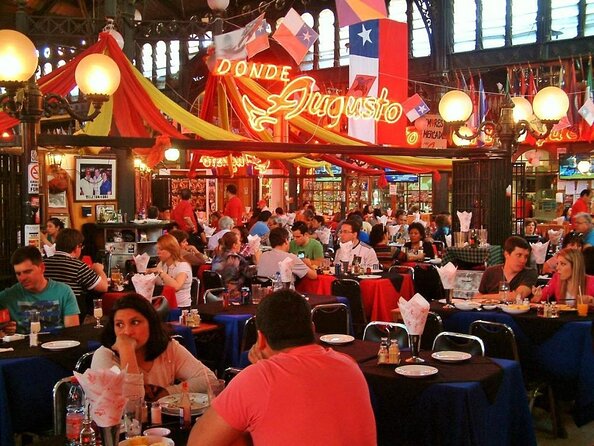
Near the end of the tour, you finish with the Central Market, Mercado Central. This is one of my favorite “last stops” because it turns all that walking into something you can smell.
The market has been highlighted as one of National Geographic’s top ten food markets worldwide. More importantly for you, it’s a mix of fresh local produce and everyday life. Even if you do not eat a full meal, you can still pause, scan stalls, and get a sense of what ingredients matter here.
Since the tour does not include food by default, you’ll decide what level of indulgence you want. This is a good moment to buy small snacks for later or to plan dinner nearby based on what you see.
Price, Group Size, and Whether This Feels Like Value
At $39.50 per person for about four hours, this can be strong value, mainly because you get a lot of high-impact seeing without needing to figure out transit.
Here is what drives the value:
- Small group experience. You are kept to a small headcount, with a maximum of 8 travelers listed. That usually means less time waiting around and more chances to ask questions.
- Hotel pickup and drop-off. In Santiago, this saves both time and mental energy, especially when you are trying to manage jet lag.
- One included hill admission depending on your choice. If you pick San Cristóbal or Santa Lucía, you get admission included, which reduces surprise costs.
- A focused downtown route that covers multiple civic landmarks in one morning-style sweep.
One practical note: not every major site is included admission-wise. Some stops like La Moneda and the Central Post Office are not included. If you care about entering those places, you may need to budget separately.
In general, the price makes most sense for first-time visitors or for people who want a high-efficiency orientation tour, not a slow museum day.
What I’d Watch For Before You Book
This tour looks great on paper, and the best experiences sound fantastic. But I do want you to be smart about risk.
A few common issues show up in real-world timing:
- Some travelers report delays or that a pick-up did not happen as planned.
- There are also reports of a stop being closed or that admissions were not handled exactly as expected at specific sites.
That does not mean you should assume trouble, but it does mean you should protect your schedule. If Santiago is your only short window, keep one extra half-day cushion. Also, if you have a must-see timed ticket later, do not stack it immediately after this tour.
On the flip side, the positive pattern is clear: well-run versions of this tour put you at the best viewpoints and keep the pace comfortable. Guides like Giovanni, Christian, Ignacio, Consuelo, Marcela, and Erik show up in the most praised experiences, and the recurring theme is clear English, friendly service, and adapting to your pace.
Should You Book the Half-Day Panoramic Tour?
Book it if you want:
- a fast orientation to Santiago’s neighborhoods
- major downtown landmarks plus one big viewpoint
- a small-group day with hotel pickup and a guide who explains what you are seeing
- an easy way to reach Bellavista and Mercado Central without planning transit
Skip or think twice if:
- you have a very tight schedule with no backup time at all
- you need guaranteed long indoor visits at specific government buildings
- you are the type who hates any possibility of a quick stop or a compressed timeline
If you pick San Cristóbal, you’ll get the Andes-and-city panorama effect. If you pick Santa Lucía, you’ll get founding-era history on a hill that feels like Santiago’s backyard. Either choice helps you “see the city” in a way that makes your next days smarter.
FAQ
How long is the half-day panoramic tour?
The tour runs about 4 hours.
What is the group size for this experience?
It is a small-group tour with a maximum of 8 travelers.
Do I get hotel pickup and drop-off?
Yes. The tour includes hotel pickup and drop-off.
Which hill can I choose to visit?
You can pre-select a visit to either San Cristóbal Hill or Santa Lucía Hill.
What major downtown sights are included?
You’ll see stops such as La Moneda and the Central Post Office area, plus other downtown landmarks along the way, with time for walking and photos.
Are any admission tickets included?
Yes, some admissions are included. San Cristóbal Hill or Santa Lucía Hill admission is included depending on your option, and Parque Bicentenario admission is included. Other stops like La Moneda and the Central Post Office are listed as not included.
Is Central Market included?
Yes. The tour includes a stop at the Central Market.
Is food included in the price?
No. Food and drinks are not included unless specified.
What if the weather is bad?
The tour requires good weather. If it is canceled due to poor weather, you’ll be offered a different date or a full refund.
Is there free cancellation?
Yes, you can cancel up to 24 hours in advance for a full refund.
The Rest Of Our Chile Tours




Everything Else We Have Reviewed In Chile

Santiago, A Few More Ways
Not quite it? Here is the rest of what we have reviewed around Chile



More in Santiago City Tours.
 ★ 4.5Tourist bus around Santiago for a dayFrom $501,857 reviews
 ★ 4.8Guided Walking Tour of the Historical Old TownFrom $25459 reviews
 ★ 4.0Private Santiago City Half Day TourFrom $76414 reviews
 ★ 4.31-Day Hop-On Hop-Off Bus and Cable Car TicketFrom $60332 reviews
 ★ 4.3Sky Costanera Observatory Admission TicketFrom $45208 reviews
 ★ 4.32-Day Hop-On Hop-Off Bus Ticket and Cable CarFrom $69162 reviews
 ★ 4.7Santiago Half-Day Walking Tour with Hotel Pick up & BrunchFrom $48148 reviews
 ★ 4.3Hop-on Hop-off Bus Day Ticket with Audio GuideFrom $50137 reviews
Browse the lists this tour appears in