
Review · SANTIAGO
Antigua Walking Tour Morning and Afternoon
Antigua can feel like a maze at first, but this walking tour gives you the map in real time. I like how the route is built around major landmarks in a logical loop, and I really enjoy the guide-led stories that explain why the city looks the way it does. One drawback to plan for: most stops do not include admission, so you may pay extra once you decide what you want to go inside.
What makes this one work is the focus on orientation plus architecture. You’ll start at the Plaza Central Park area and walk through earthquake history, baroque design, and convent life, with a local guide who can bring it all to life. In recent tours, guides like Armando and Moisés have stood out for strong English and clear explanations, which matters when you only have a half day.
Pace is comfortable and realistic for a sightseeing morning or afternoon, with an approximate duration of 3 hours 30 minutes and a small group size (up to 15). Still, it’s a walking tour, so wear good shoes and consider bringing your own water since bottled water and coffee or tea are not included.
In This Review
- Key highlights from the route
- Plaza Mayor orientation: the 1541 city plan and Sirens fountain
- Catedral de San José: faith, ruins, and rebuilding after earthquakes
- Museo de Arte Colonial: USAC context without getting lost in lectures
- Iglesia de San Francisco el Grande: baroque layers and a saint’s resting place
- Concepción Convent ruins by the Pensativo River and Sister Juana
- Casa Santo Domingo: baroque architecture turned into a museum and hotel space
- Mercado de Artesanías finish: shop near the action
- Price and included value: what $27 buys you in Antigua
- Who should book this Antigua walking tour
- Should you book it
- FAQ
- How much does the Antigua Walking Tour cost?
- How long is the tour?
- Are admissions included?
- Where does the tour start and end?
- What is the maximum group size?
- What if the weather is bad?
Key highlights from the route
- Plaza Mayor starting point with a 1541 layout story, plus the Sirens fountain built in 1739 by Diego de Porres
- Catedral de San José within the footprint of earlier Santiago cathedrals reshaped by earthquakes
- Museo de Arte Colonial and the University of San Carlos (USAC) context that ties the city to Guatemala’s oldest university
- Iglesia de San Francisco el Grande and the tomb connection to Pedro de San José de Betancur
- Concepción Convent ruins along the Pensativo River, linked to Sister Juana de Maldonado
- Casa Santo Domingo in a former Santo Domingo convent, now a museum focused on baroque colonial architecture
Other Chilean towns worth doing on foot
- Walk Antigua Like a Local
★ 5.0 · 53 reviews - Private Walking tour of Antigua Guatemala
★ 4.5 · 40 reviews
Plaza Mayor orientation: the 1541 city plan and Sirens fountain
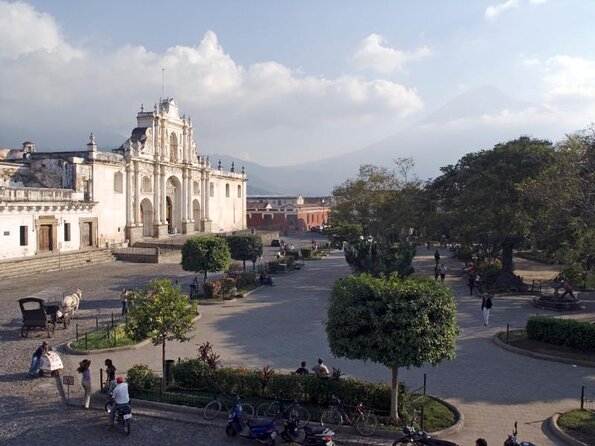
The tour begins at the Plaza Central Park area, with the Plaza Mayor as your first real landmark. This is not just a pretty square, it is the organizing idea of Antigua. In 1541, the city was planned in a reticulated, grid-like layout centered on the main square, and that structure still drives how you move through Antigua today.
What I like most at this stop is the mix of scale and specifics. You’ll learn the plaza’s measurements, about 112 meters north to south and 115 meters east to west, and you’ll hear how the main civic and religious buildings were supposed to face inward toward the square. You also get a quick visual map of key corners, including the portal of Chains, the Palace of the Noble City Hall, and the cathedral area.
Look for the Sirens in the center, a fountain built in 1739 by Diego de Porres. It’s the kind of detail you might miss on your own, and it gives you something concrete to point to while your guide explains the city’s original rhythm.
Tip for you: take 3 minutes here to stand back and look at the whole square, then notice where you’ll walk next. That small pause makes the rest of the route feel less random.
Catedral de San José: faith, ruins, and rebuilding after earthquakes
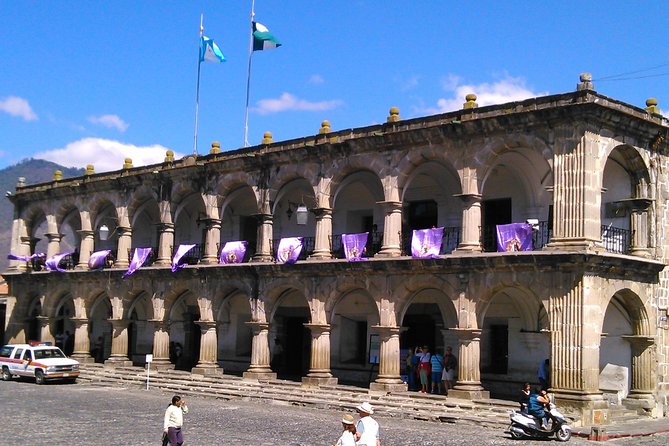
Next you’ll head to Catedral de San José, tied to the former Cathedral of Santiago de los Caballeros. The story is very Antigua: earthquakes repeatedly changed what stood here, so the “cathedral” you see now is part of a longer sequence of construction, damage, demolition, and rebuilding.
You’ll hear that the first building began in 1545 with debris brought from the destroyed settlement in the Almolonga valley, and that frequent earthquakes slowed progress for years. Then, on April 7, 1669, the earlier temple was demolished, and a second sanctuary was inaugurated in 1680 under Juan Pascual and José de Porres.
This stop can feel slightly heavy if you like your sightseeing light, but that’s also why it is valuable. It explains Antigua’s signature look: not only beautiful stonework, but a city shaped by repeated rebuilding. In other words, the ruins are not a side story. They are part of the main story.
Practical note: entry fees are not included at this stop, so if you want to go inside, budget a bit extra.
Museo de Arte Colonial: USAC context without getting lost in lectures
Then you shift from church history to museum and education. At Museo de Arte Colonial, you’ll connect Antigua to the University of San Carlos de Guatemala, known as USAC, which is Guatemala’s largest and oldest university and the only national university in the country.
Even if you only spend a short moment here, the context helps you read Antigua better. You’ll learn that USAC dates back to the Spanish colonial era and was once the only university in Guatemala until 1954. The tour also frames the Royal and Pontifical University of San Carlos Borromeo, which was established in the 17th century, approved by the Holy See, and directed by regular Catholic orders.
The benefit for your brain is simple: you start seeing Antigua not only as a postcard of churches and ruins, but as a place where learning and cultural institutions mattered. That adds depth without turning the walk into a classroom.
As with other sites, admissions are not included, so decide on the spot if you want to pay to see more. If you’re short on time, you can still get a lot just from the outside and the explanation.
Other Chilean early starts
Iglesia de San Francisco el Grande: baroque layers and a saint’s resting place
Iglesia de San Francisco el Grande is one of those stops where Antigua’s layers are obvious. The sanctuary tradition here goes back to the mid-1500s, but it suffered deterioration after a strong earthquake in 1565.
The current church was built in 1702 by Diego de Porres. And as if Antigua needed to prove a point, the church was destroyed by earthquakes in 1717, 1751, and 1773. The site later went through more damage after earthquakes in 1874 and 1917, then was rebuilt in the second half of the 20th century when regular orders regained ownership, with Franciscans returning in 1967.
The church is especially known for housing the tomb of Pedro de San José de Betancur, a missionary in Guatemala and a saint of Spanish origin. That’s a big enough detail that it helps you feel the emotional side of the architecture, not only admire the structure.
If you like guided storytelling, this is a great stop. It gives you a clear timeline you can keep in your head while you look at the building.
Again, admission is not included here, so if you want to go inside and linger, plan for possible fees.
Concepción Convent ruins by the Pensativo River and Sister Juana
After the church focus, you’ll reach the Concepción Convent ruins. This is a different kind of scene, more atmospheric, because you’re looking at remains of a complex rather than a fully operating church.
The location matters: it sits on the banks of the Pensativo River. You’ll also hear the story of Sister Juana de Maldonado, a poet considered one of Antigua’s more controversial and interesting historical figures. She is linked to the convent as an urban nun in the early 17th century.
This stop can be a highlight if you like human stories. It’s also a reminder that convent life was woven into the city’s social fabric, not tucked away in some separate world. Even the ruins point to that connection.
Because it’s ruins, you may get the most value from looking slowly, taking in layout cues, and letting the guide’s story connect the dots. If you’re traveling with a tight schedule, this is also one of those places where you can choose to spend a little more time without breaking the rest of your afternoon.
Casa Santo Domingo: baroque architecture turned into a museum and hotel space
Next is Casa Santo Domingo Museums, housed in what used to be the Santo Domingo convent. This is where Antigua’s “old world” feel gets extra tangible, because the space is preserved and curated around the baroque colonial look.
The guide frames it as one of the largest convents in America, and tells you that Casa Santo Domingo opened in June 1989. Even if you are not a museum person, I like this stop because it offers a change of pace from churches and ruins. You’re moving into a building that has been maintained, so the details you miss on outdoor façades can be more visible.
You’ll learn it’s a 5-star hotel and museum, with baroque architecture preserved and displayed treasures from the era. That combo can be a pro or a con depending on your style. If you love authenticity, it’s a strong way to experience colonial craftsmanship. If you want pure street-level simplicity, you might prefer to spend more time outside and then stroll the market afterward.
Admission is not included, so if you want to see the museum exhibits, expect an extra cost.
One smart move: treat this as a “slow your pace” stop. Even a short visit gives you a sense of what the convent complex likely felt like when it was full and active.
Mercado de Artesanías finish: shop near the action
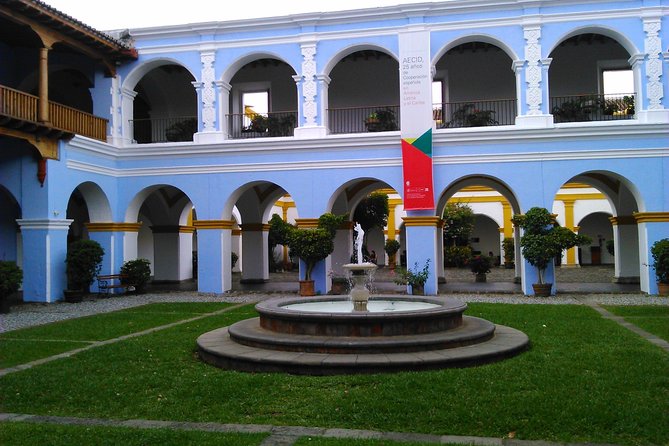
The tour ends at Mercado de Artesanías, which is convenient because it’s a natural place to keep your afternoon going. You can browse and pick up small gifts without needing to hop across town.
One practical detail: the tour information notes that shopping here is easy and that this market is about two blocks away from the Central Plaza area. That means you’re not far from more food and more walking if you want to extend your day.
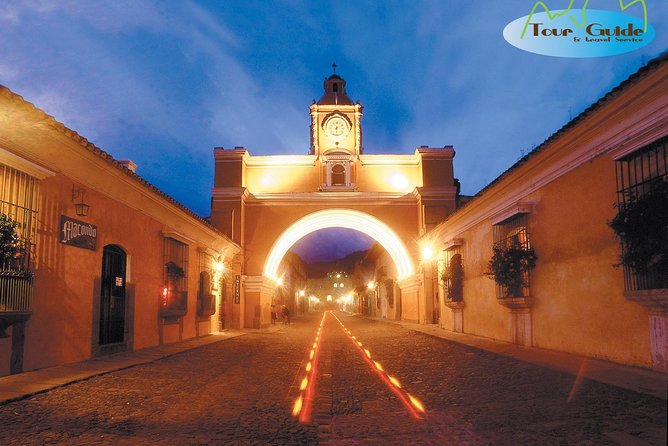
There’s also a free stop that pairs with this market block: La Iglesia de Nuestra Señora del Carmen is referenced as having a well-preserved façade even after destruction, and it’s known for its example of barroco sísmico guatemalteco. The façade story is interesting even if you don’t go inside, and it adds one more earthquake-shaped piece to the Antigua puzzle.
Because this is where you finish, you’ll leave with enough context to shop with intention. You’ll know what kind of colonial influence you’re looking at and why certain design elements keep showing up.
Price and included value: what $27 buys you in Antigua
At $27 per person for an approximate 3 hours 30 minutes tour, you’re paying for a guided walking route plus local interpretation. That’s a good value for Antigua because so much of what you see is old, layered, and easy to misunderstand without a guide connecting the dots.
What’s included is the tour guide. What is not included is bottled water, coffee or tea, and admissions at several major stops. Only the Mercado de Artesanías-related church stop is described as free, so assume you might add a few entry fees if you go inside museums and churches.
This matters for your budget planning. If you want mostly exterior photo time and explanations, the $27 covers the core experience. If you want to enter multiple buildings, set aside extra cash so you don’t feel rushed when you reach the ticket windows.
It also helps that the group is capped at 15. Smaller groups tend to mean more direct questions and less time waiting for everyone to catch up.
One more practical point: this is a good pick if you often arrive in Antigua and want to build a mental map fast. Once you understand the layout and the earthquake timeline, you’ll enjoy the rest of your free wandering much more.
Who should book this Antigua walking tour
This is a strong fit if you want an organized orientation without turning your day into a museum marathon. It’s ideal for first-timers who need context, and it also works for repeat visitors who want a clearer story than they get from reading signs.
You’ll likely enjoy it most if you like:
- architecture that tells a story, not just beautiful photos
- walking with a guide who can connect sites into one timeline
- a half-day plan that ends near shopping
If you hate paying extra for admissions, you might prefer a tour that includes entry. If you are very sensitive to uneven terrain, you’ll want to wear sturdy shoes and take your time, since this is a walking route with churches, plazas, and museum areas.
Service animals are allowed, and the tour is near public transportation, so it can be easier to fit into a broader itinerary than a remote day trip.
Should you book it
Yes, I think you should book this Antigua Walking Tour Morning and Afternoon if you want the city’s colonial layout and earthquake story explained in a way you can actually remember while you walk. The $27 price feels fair because the guide does the heavy lifting, and the route hits key places that shape how Antigua looks and functions.
I would book it confidently if you’re open to paying a bit extra for admissions at stops you choose to enter. If you want only free exterior viewing, consider that some of the most detailed parts may require entry.
FAQ
How much does the Antigua Walking Tour cost?
The price is $27.00 per person.
How long is the tour?
It runs about 3 hours 30 minutes.
Are admissions included?
No. Admissions are not included for the listed major stops, and bottled water and coffee or tea are also not included.
Where does the tour start and end?
It starts at Café Condesa La Casa del Conde on Avenida Norte 5a in Antigua Guatemala. It ends at Mercado de Artesanías on 3a Avenida Nte.
What is the maximum group size?
The tour has a maximum of 15 travelers.
What if the weather is bad?
The experience requires good weather. If it is canceled due to poor weather, you will be offered a different date or a full refund. You can cancel up to 24 hours in advance for a full refund.
Chile On Foot, Continued

The Rest Of Our Chile Tours


Everything Else We Have Reviewed In Chile


Not quite it? Here is the rest of what we have reviewed around Chile




More in Walking Tours.
 ★ 4.6Walk with Penguins on Magdalena & Marta IslandFrom $150611 reviews
 ★ 4.8Guided Walking Tour of the Historical Old TownFrom $25459 reviews
 ★ 4.7Santiago Half-Day Walking Tour with Hotel Pick up & BrunchFrom $48148 reviews
 ★ 4.5Walk alongside Penguins on Magdalene Island and navigate Marta IslandFrom $140116 reviews
 ★ 4.4Private Custom Walking tour with A GuideFrom $3688 reviews
 ★ 5.02-Hour Walking Tour of Yungay The Coolest Neighborhood in ChileFrom $3585 reviews
 ★ 5.0Valpo in 1 day: Authentic + Famous! Semi-private walking tour & public transportFrom $8084 reviews
 ★ 5.0Famous Valparaíso! Premium Walking Tour with a Native GuideFrom $4080 reviews
Browse the lists this tour appears in